
I’ve seen this pattern too many times.
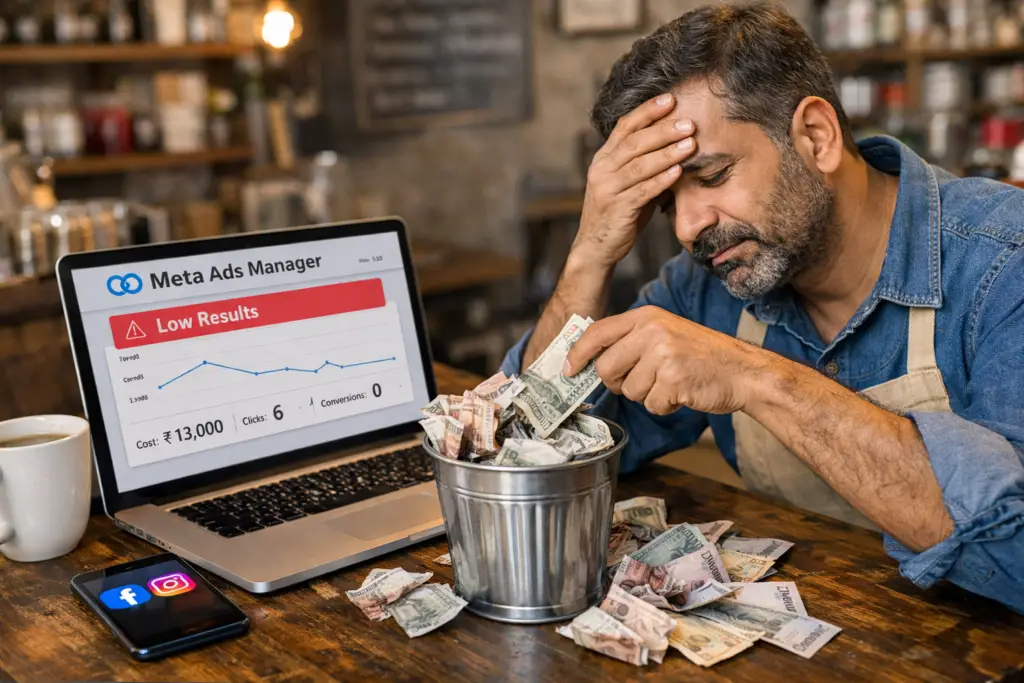
A small business owner runs ads for a few weeks, spends a decent amount of money, and then says something like:
“Online ads don’t work.”
But when you look a little closer, the ads were never really the problem.
It’s usually everything around the ads.
The strategy, the expectations, the message, the audience. Advertising tends to magnify whatever foundation already exists. If the foundation is weak, ads simply make the weakness more expensive.
And this is exactly where many small businesses get stuck.
They’re not failing because they lack effort. Most of them are trying very hard. The problem is they’re approaching ads like a quick fix instead of part of a bigger marketing system.
Let’s talk about what’s actually happening.
The “ads will bring customers” assumption
A lot of business owners start ads with one simple expectation.
“If people see my ad, they will buy.”
It sounds logical. But human behavior is rarely that simple.
Think about your own scrolling habits for a moment.
You see dozens of ads every day. Most of them disappear from your memory within seconds. Not because the businesses are bad, but because you simply don’t know them.
People rarely buy from brands they’ve never heard of. Especially online.
Trust comes first.
Small businesses often skip this step. They jump straight into sales ads aimed at complete strangers.
That’s a tough position to win from.
It’s a bit like walking up to someone you’ve never met and immediately asking them to invest money in you. Even if your offer is great, the timing feels wrong.
What usually works better is warming people up first. Showing your work, sharing useful insights, posting behind the scenes moments, letting people see the human side of the business.
When people see you repeatedly, something interesting happens psychologically.
Familiarity grows.
And familiarity quietly builds trust.
Only then do ads start feeling less like interruptions and more like opportunities.
The “target everyone” mistake
Another thing I notice with small businesses is overly broad targeting.
Someone opens the ad settings and thinks, “The more people I reach, the better.”
So they target an entire city, sometimes even an entire state.
On paper it looks exciting. Huge audience numbers.
In reality it usually burns money.
Because most of those people were never potential customers in the first place.
Let’s say a gym advertises to everyone aged 18 to 60. That sounds reasonable until you think about it for a moment.
Half those people probably dislike gyms. Some already have memberships. Others simply aren’t interested in fitness right now.
So the ad becomes background noise.
Good marketing works in the opposite direction.
It narrows things down.
Instead of “everyone”, it focuses on very specific groups. Office workers who sit long hours. People searching for weight loss tips. Individuals already following fitness pages.
Suddenly the message feels more personal.
And when people feel like something was made specifically for them, they pay attention.
That’s basic psychology at work.
Weak messaging that sounds like every other ad
Here’s another subtle issue.
Many ads sound almost identical.
“Best quality service.”
“Trusted professionals.”
“Top real estate deals.”
None of these statements are technically wrong. But they’re also not memorable.
They’re the kind of phrases our brains skip automatically because we’ve seen them thousands of times.
Customers respond much better to specifics.
Instead of saying “Luxury villas available,” imagine seeing an ad that says:
“Private pool villas in North Goa, starting from ₹5 Cr, limited units available for 2026 possession.”
Now the brain immediately understands what’s being offered.
Clarity is powerful.
When people instantly understand the value, they’re far more likely to take the next step.
When they feel confused, they move on.
And online, moving on happens very quickly.
The hidden leak after people click
This one is interesting because many businesses never notice it.
They focus heavily on getting clicks. But they forget what happens after someone clicks.
Let’s say someone taps your ad.
Maybe they land on a slow website. Maybe your Instagram page hasn’t been updated in weeks. Maybe there’s no clear next step.
That small moment creates doubt.
And doubt quietly kills conversions.
From a psychological perspective, people are always scanning for signals of professionalism and reliability.
Clean visuals, active profiles, clear information, quick responses. These things reassure people that the business is real and serious.
Ads can only open the door.
The experience afterward decides whether someone walks in or walks away.
Expecting ads to work instantly
This might be the most common frustration.
Someone runs ads for a week, doesn’t see immediate profit, and stops.
It’s understandable. Small businesses have limited budgets.
But advertising rarely works like flipping a switch.
Early campaigns are often about learning. They reveal which audience responds, which message resonates, and which creative actually stops the scroll.
Good marketers treat ads like experiments.
They test different headlines. Different visuals. Slightly different audiences.
Over time patterns appear.
Something starts performing better than the rest.
And that’s where real scaling begins.
Businesses that stop too early never reach that stage.
The creative problem nobody talks about
In social media advertising, attention is everything.
If the visual doesn’t stop someone mid scroll, the rest of the message doesn’t matter.
But many small business ads look rushed.
Blurry images, overcrowded posters, too many fonts, too much text.
Ironically, the best performing ads today often look simpler and more natural.
Short videos. Real photos. Authentic moments.
Content that feels human.
Perfect studio level designs sometimes perform worse because they feel like obvious ads.
And people are trained to ignore obvious ads.
Authenticity tends to break through that resistance.
The Real Lesson Behind All of This
Advertising itself is not the problem.
Ads are just amplifiers.
They amplify your message, your positioning, your credibility.
If those pieces are strong, ads accelerate growth.
If those pieces are weak, ads simply expose the cracks faster.
That’s why experienced marketers spend far more time thinking about strategy than pressing the “Promote” button.
For small businesses, the biggest advantage isn’t having a massive budget.
It’s understanding people.
How attention works. How trust forms. How decisions get made.
Once you start seeing marketing through that lens, advertising stops feeling like a gamble.
And starts feeling like a tool you can actually control.