
You launched the ad. You set the budget. You waited.
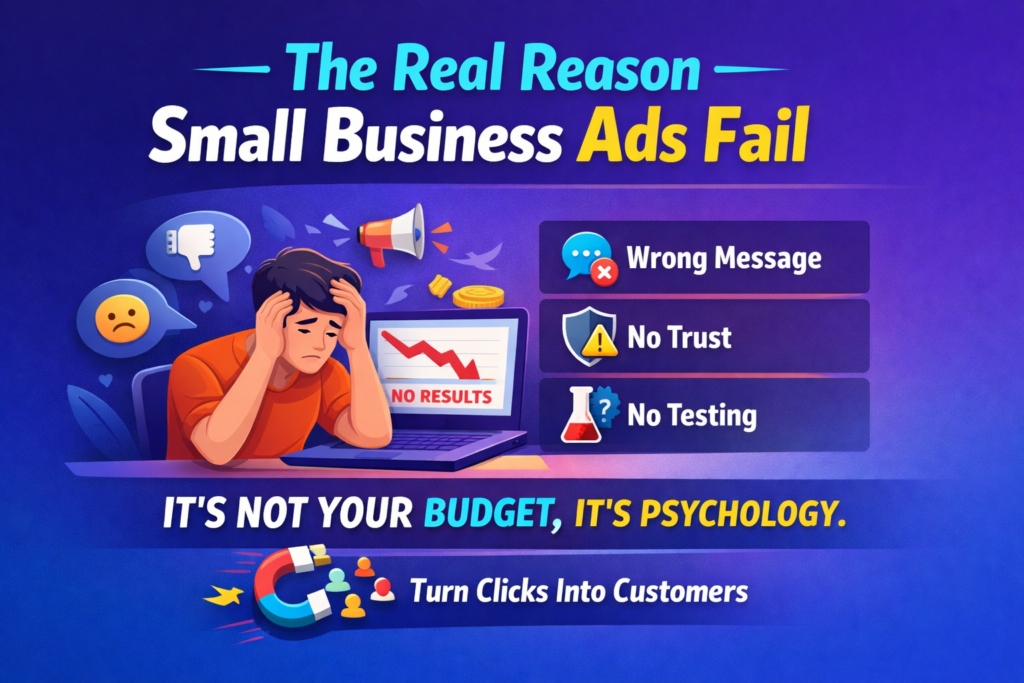
And then… nothing. A few clicks, maybe. A handful of impressions. Zero sales.
Sound familiar? You’re not alone. Every week, thousands of small business owners pour money into Facebook, Instagram, and Google ads — and walk away wondering what went wrong. Most of them blame the platform. Some blame the algorithm. A few blame their budget.
Almost none of them look at the real problem.
Here’s the hard truth: your ads aren’t failing because of bad luck. They’re failing because of how people actually think.
What Most Small Business Owners Get Wrong About Digital Ads
Let’s start with the most common mistake I see.
A bakery owner in Pune decides to run a Facebook ad. She picks a nice photo of her cupcakes, writes “Best cupcakes in town! Order now,” and hits publish. She spends ₹3,000 over a week. Gets 12 clicks. Zero orders.
She concludes: “Facebook ads don’t work for small businesses.”
But here’s what actually happened — her ad had no reason for a stranger to care.
Think about your own scrolling behavior. You’re moving fast. Your brain is filtering out hundreds of pieces of content every minute. For something to stop you mid-scroll, it needs to do one thing almost instantly: make you feel something relevant to your life.
“Best cupcakes in town” tells me nothing about my world. But “Stressed about your kid’s birthday? We deliver custom cakes in 24 hours” — now you’ve got my attention, because that’s a real problem I recognize.
This is called message-to-market match, and most small business ads completely miss it.
The Real Reason Your Facebook and Instagram Ads Aren’t Converting
Here’s a psychology principle that changes everything once you really get it:
People don’t buy products. They buy a better version of themselves, or relief from a problem that’s bothering them.
A gym isn’t selling memberships. It’s selling confidence, energy, and the feeling of being in control of your body.
A local accountant isn’t selling bookkeeping. She’s selling the relief of not lying awake at 2 AM worrying about taxes.
When small businesses write ads, they almost always lead with what they do rather than what the customer gets. “We offer premium IT services” means nothing to a small business owner. “Stop losing hours to tech problems — we fix it fast so you can focus on running your business” means everything.
The shift is subtle but the impact is massive. Before you write your next ad, ask yourself: what does my customer feel before they find me, and what do they feel after? Write about that gap.
Why People Don’t Buy From Ads They’ve Never Seen Before
Here’s something that surprises a lot of people: most of your ad audience has never heard of you.
They don’t know you. They don’t trust you. And you’re asking them to pull out their wallet.
Would you buy something from a stranger who walked up to you on the street and said “Hey, buy my product, it’s great”? Probably not. But that’s exactly what most small business ads do.
Digital marketing has a concept called the “know, like, trust” ladder. Before someone buys from you, they need to at least partially climb that ladder. Cold ads — ads shown to people who’ve never encountered your brand — work much better when they’re designed to start a relationship, not close a sale.
This is why retargeting ads (ads shown to people who’ve already visited your site or engaged with your content) convert so much better than cold ads. The person has already met you once. The trust ladder is halfway climbed.
Practical fix: Run two types of campaigns. One to introduce yourself to new audiences (awareness). Another to follow up with people who’ve already shown interest (retargeting). Most small businesses run only the first type and wonder why conversions are low.
How Poor Ad Targeting Wastes Your Marketing Budget
“I targeted everyone aged 18–65 in my city,” a client once told me, almost proudly.
That’s not targeting. That’s hoping.
Great targeting isn’t about reaching the most people. It’s about reaching the right people at the right moment. A 45-year-old woman who just searched “birthday cake delivery near me” is worth a hundred random 25-year-olds who might theoretically like cupcakes.
On the flip side, I’ve seen small businesses go too hyper-specific and shrink their audience to almost nothing — targeting by three layers of interests and behaviors until only 400 people qualify.
The sweet spot is targeting people who are already in problem-solving mode. Google Search ads are brilliant for this — you’re reaching someone who literally typed in what they need. Facebook and Instagram require a bit more creativity, but interest targeting, lookalike audiences (people similar to your existing customers), and behavioral signals can get you close.
The Psychology Behind Why People Click (And Why They Don’t)
You’ve probably heard “content is king.” In paid ads, creative is king.
Your image or video has about 1.5 seconds to earn a person’s attention as they scroll. That’s it. If it looks like every other ad in their feed — stock photo, logo, a phone number — it’s invisible.
What stops people? Faces. Genuine emotion. Something unexpected. A result that seems almost too good. Bold text that calls out a specific person or problem (“Are you a Pune restaurant owner?”).
What kills ads? Over-designed graphics that look like a flyer. Generic phrases like “quality service” or “trusted since 2010.” Ads that look like… ads.
The weird irony is that lo-fi content — an honest 30-second video shot on your phone, or a real photo of a customer with a short quote — often dramatically outperforms expensive, polished creatives. Because it feels real. And people are wired to trust what feels real.
Why Your Landing Page Is Killing Your Ad Conversions
You finally get someone to click. And then you send them to your homepage.
Your homepage is not a sales page. It’s a welcome mat. It’s designed for everyone, which means it’s optimized for no one.
When someone clicks an ad about “24-hour cake delivery,” they expect to land on a page that says exactly that — with a clear way to order. Instead, they land on a homepage full of menus, about pages, and a slideshow. They get confused. They leave.
This disconnect between the ad promise and the landing page experience is called message mismatch, and it silently kills conversion rates. Match your landing page to your ad. Make the next step obvious. Remove distractions. One clear call to action.
How to Fix Your Small Business Ads: A Step-by-Step Breakdown
Before you run your next ad, check these off:
- Write for one person, not everyone. Picture your ideal customer and write directly to their specific problem.
- Lead with the outcome, not the service. What changes in their life after they buy from you?
- Warm up cold audiences first. Use content and awareness ads before pushing for a sale.
- Match your ad to a dedicated landing page with one clear call to action.
- Test your creative honestly. Show it to someone outside your business and ask: would you stop scrolling for this?
- Set up retargeting. Follow up with people who’ve already shown interest — this is where most of your ROI hides.
Conclusion
Small business ads fail not because small businesses are bad at marketing — but because most people never learn how human psychology actually drives buying decisions.
Your customers aren’t logic machines. They’re busy, distracted, skeptical people who are trying to solve problems and feel good about their choices. Your job isn’t to shout louder. It’s to show up at the right moment, with the right message, for the right person.
When you understand that — really understand it — ads stop feeling like a gamble and start feeling like a conversation.
And conversations, done right, convert.