
Moment Before the Click
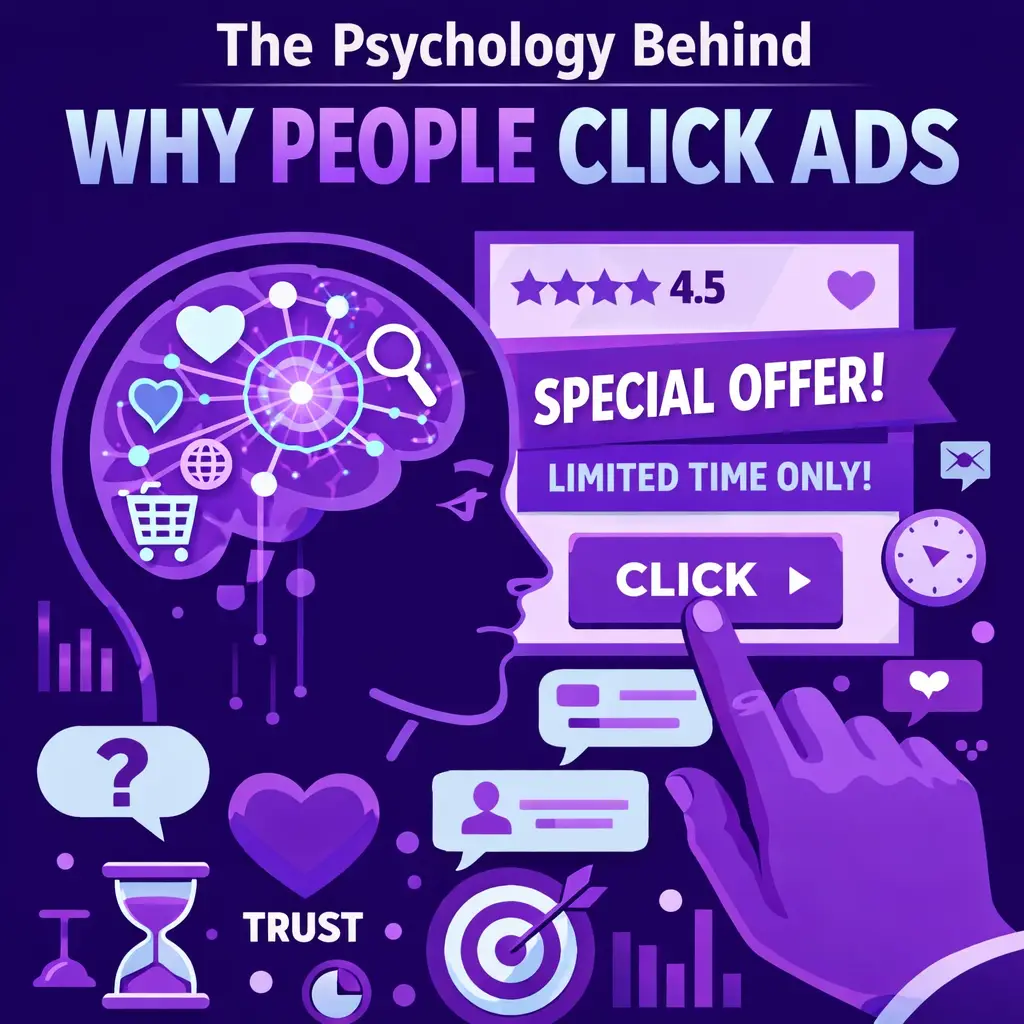
Think about the last time you clicked an ad.
Maybe it was on Instagram. Maybe a Google search. Maybe a YouTube video you were about to skip, but something about it made you stop.
You probably didn’t sit there and logically analyze the ad.
You just clicked.
That tiny action, a single tap or click, is the result of a complex psychological process happening in the human brain within seconds.
As marketers, understanding this moment is powerful. Because people don’t click ads simply because a product exists. They click because something inside the ad triggers curiosity, emotion, urgency, or relevance.
Good ads are not about shouting louder. They are about understanding how humans think.
Let’s break down the real psychology behind why people click ads, and how smart marketers use it.
1. The Brain Loves Relevance
The human brain is constantly filtering information.
Every day we scroll past hundreds of posts, stories, videos, and ads. Our brain quickly decides what matters and what doesn’t.
So when an ad feels relevant, the brain pauses.
This is why Google Ads works so well.
Imagine someone searches:
“AC repair near me”
If your ad says:
“Fast AC Repair in Goa, Same Day Service”
The brain instantly recognizes relevance.
This person is already looking for a solution. The ad simply appears at the perfect moment.
This is called intent-based marketing.
Instead of interrupting people, you meet them when they already want something.
Practical insight:
If your ad feels like it was made for that exact person, the chances of clicking increase dramatically.
That is why targeting matters so much.
2. Curiosity Is One of the Strongest Psychological Triggers
Humans hate information gaps.
When our brain notices something incomplete, it wants to close the gap.
This is why headlines like these work:
• “Most small businesses make this ad mistake”
• “The reason your Facebook ads are failing”
• “What marketers don’t tell you about Instagram ads”
Your brain immediately asks:
What mistake?
That curiosity creates a small tension in the mind. The easiest way to release that tension is to click.
Great marketers intentionally create curiosity gaps.
But here is the important part.
The curiosity must feel genuine, not clickbait.
Bad curiosity makes people angry.
Good curiosity makes people interested.
Example:
Bad ad
“Make $10,000 tomorrow”
Good ad
“Why most small businesses waste money on ads”
One feels fake. The other feels believable.
People click when curiosity meets credibility.
3. Humans Respond to Emotional Signals
People like to believe they make logical decisions.
But in reality, emotions drive most actions.
Logic usually justifies the decision later.
Ads that perform well usually trigger one of these emotions:
• Fear
• Desire
• Relief
• Curiosity
• Belonging
• Status
Let’s look at a simple example.
Ad version 1
“Buy our fitness program”
Ad version 2
“Lose your belly fat without spending hours in the gym”
The second one speaks to a pain point.
It connects emotionally.
Another example in digital marketing.
Ad headline:
“Your website might be losing customers”
That creates mild anxiety.
Now the brain wants to know why.
Emotion is the fuel behind attention.
Without emotion, ads become invisible.
4. Humans Trust Other Humans
This is where social proof becomes powerful.
Imagine two ads.
Ad A
“Best digital marketing services”
Ad B
“Trusted by 120+ businesses”
Which one feels more believable?
Humans constantly look for signals that others have already made the decision.
Reviews, testimonials, case studies, and ratings all reduce psychological risk.
This is why Amazon reviews matter so much.
Before buying something, people often scroll straight to reviews.
The brain is asking:
“Did this work for someone else?”
If the answer is yes, the click becomes easier.
Practical insight:
Adding simple trust signals can improve click rates significantly.
Examples:
• Customer testimonials
• Real results
• Client logos
• Ratings
• Before and after results
People trust people more than brands.
5. Simplicity Wins Attention
The human brain loves shortcuts.
When information feels complicated, the brain simply skips it.
This is why simple ads outperform complex ones.
Let’s compare two ad styles.
Complex ad
“Comprehensive digital marketing solutions for scalable growth across multiple digital platforms”
Simple ad
“Get more customers from Google and Instagram”
The second one wins instantly.
Why? Because the brain understands it immediately.
The faster someone understands your ad, the higher the chance they click.
This is why great ads often follow a simple structure:
Problem → Solution
Example:
“Website getting traffic but no leads?”
“Let us fix your conversion problem.”
Clear. Direct. Clickable.
6. The Power of Visual Attention
Humans process visuals much faster than text.
In fact, our brains are designed to notice visual changes quickly. This comes from survival instincts.
When scrolling through social media, people react first to:
• Faces
• Movement
• Bright contrast
• Emotional expressions
• Unexpected visuals
This is why ads with real people often outperform stock graphics.
For example, imagine two real estate ads.
Ad 1
Just a photo of the villa.
Ad 2
A person standing in front of the villa holding a sign saying “Luxury Villa For Sale”.
The second ad feels more human.
It catches attention because people naturally look at other people.
This psychological instinct is deeply rooted in how we evolved.
7. Scarcity and Urgency Push People to Act
Another strong psychological trigger is scarcity.
When something feels limited, the brain gives it more importance.
Think about phrases like:
• “Limited offer”
• “Only 3 spots left”
• “Offer ends tonight”
Suddenly the decision feels more urgent.
Without urgency, people often think:
“I’ll check later.”
And later usually means never.
This is why flash sales, countdown timers, and limited slots work so well.
They push the brain out of procrastination mode.
But again, authenticity matters.
Fake urgency destroys trust.
Real scarcity increases action.
8. The Brain Loves Easy Decisions
Clicking an ad should feel effortless.
If people feel confused about what happens next, they hesitate.
This is where clear calls to action matter.
Instead of vague CTAs like:
“Learn more”
You can be more specific:
• “Get a free website audit”
• “Book your AC service today”
• “See how your ads are performing”
The brain likes clear outcomes.
When the next step is obvious, clicking becomes easier.
Actionable Takeaways for Marketers
If you remember only a few things from this article, remember these.
People click ads when:
• The ad feels personally relevant
• Curiosity is triggered
• Emotion is involved
• Social proof builds trust
• The message is simple
• Visuals catch attention
• Scarcity pushes urgency
• The next step is clear
Great advertising is not manipulation.
It is understanding human behavior.
The more you understand people, the better your ads perform.
Conclusion, Marketing Is Psychology in Action
At its core, marketing is not really about products.
It is about people.
Every click is a small psychological decision.
A moment where curiosity, emotion, trust, and relevance come together.
The best marketers are not just good with ads platforms like Google or Meta.
They understand how the human mind works.
When you combine psychology with smart strategy, ads stop feeling like interruptions.
They start feeling like helpful solutions.
And that is when people click.
Want Ads That Actually Work?
If you’re a business owner struggling with ads that bring clicks but no real customers, the problem is rarely the budget.
It is usually the strategy behind the ads.
If you’d like help building campaigns that combine smart targeting with real marketing psychology, feel free to reach out through aayes.in. I’d be happy to take a look at your current ads and see where they can be improved.